blog
Best Locked Savings Accounts: How to Save When You Keep Spending It
Comparing the best locked savings accounts for people who keep dipping into their savings. See how each option works and which fits your goals.

Best Locked Savings Accounts: How to Save When You Keep Spending It
If you have ever moved money into savings with the best intentions, only to spend it three weeks later on something that felt important at the time, you are not bad with money. You just have easy access to it. That is the real problem.
A locked savings account puts friction between you and your balance. Some do it with time delays. Some do it with penalties. Some do it by physically removing the money from your regular banking view. The right one depends on what kind of saver you are and what is actually causing you to dip in.
This post compares the most common types of locked savings options, explains how each one works, and helps you figure out which approach is likely to stick for you.
Table of Contents
- Why locking savings actually works
- Option 1: CDs (Certificates of Deposit)
- Option 2: High-yield savings accounts with withdrawal limits
- Option 3: Savings accounts at a separate bank
- Option 4: Fixed-term savings bonds
- Option 5: Locked goal savings apps
- How to compare these options side by side
- Who each option actually suits
- The one thing all these options have in common
Why Locking Savings Actually Works
Willpower is not infinite. Research on behavioral economics has shown repeatedly that humans are wired to prefer immediate rewards over future ones, a concept called hyperbolic discounting. In plain terms: the money in your account right now feels more real than the vacation you are planning for eight months from now.
Locked savings accounts work not because they make you more disciplined, but because they change the math. When spending your savings carries a concrete cost, whether that is an early withdrawal penalty, a lost interest rate, or a visible fee, the immediate reward of spending starts to feel less worthwhile.
The friction is the product. That is true whether you are looking at a traditional bank CD or a newer app-based commitment savings tool.
If you want to read more about the psychology behind this, the Bloomin blog has a solid piece on how to stop touching your savings that gets into the behavioral side without turning it into a lecture.
Option 1: CDs (Certificates of Deposit)
A CD is probably the most well-known locked savings option. You deposit a fixed amount with a bank or credit union for a set term, anywhere from three months to five years. During that term, the bank pays you a guaranteed interest rate. When the term ends, you get your principal back plus the interest earned.
The lock is an early withdrawal penalty. Pull money out before the term ends and you forfeit a portion of the interest you would have earned, sometimes several months' worth.
How strong is the lock?
Fairly strong in practice, though it depends on the penalty structure. Some CDs have soft penalties (30 to 60 days of interest), which is not much of a deterrent. Others impose penalties that can actually eat into your principal if you withdraw early enough in the term. Read the terms before you commit.
What is the upside?
CDs typically pay higher interest than standard savings accounts, especially for longer terms. Rates fluctuate with the broader market, so the returns you see today may not be available next year.
What is the downside?
The money is locked to a schedule, not a goal. If you are saving for a down payment but your lease ends sooner than expected, a CD does not care. You either pay the penalty or wait.
Also, there is no visual or psychological connection to what the money is for. You deposit a lump sum and see a maturity date. That is a weak motivational frame for most people who struggle to save consistently.
Best for: People who already have a lump sum saved and want to park it somewhere it cannot easily be touched while earning a reasonable return.
Option 2: High-Yield Savings Accounts With Withdrawal Limits
High-yield savings accounts (HYSAs) pay significantly more interest than a standard bank savings account. Many online banks offer HYSAs with rates that beat traditional branches by a wide margin.
Some of these accounts come with monthly withdrawal limits, sometimes called Regulation D limits, though many banks have relaxed these restrictions in recent years. Others build their own limits or notice periods into the account design.
How strong is the lock?
Weaker than a CD. Most HYSAs let you move money out within a day or two, sometimes immediately. The friction is low. You might see a modest rate drop or lose a few days of interest, but it is not enough to stop someone who really wants to spend.
What is the upside?
A great interest rate with relatively easy access if you genuinely need emergency funds. For disciplined savers who just want better returns on money they are already not touching, a HYSA is hard to beat.
What is the downside?
If your problem is that you keep dipping into savings, a HYSA does not solve it. It gives you a better return on money you still might spend.
Best for: People who are already saving consistently and want to maximize the interest they earn on money they are unlikely to touch.
If you are shopping around for HYSA options, this overview from NerdWallet covers some of the top-rated accounts across different categories:
Option 3: Savings Accounts at a Separate Bank
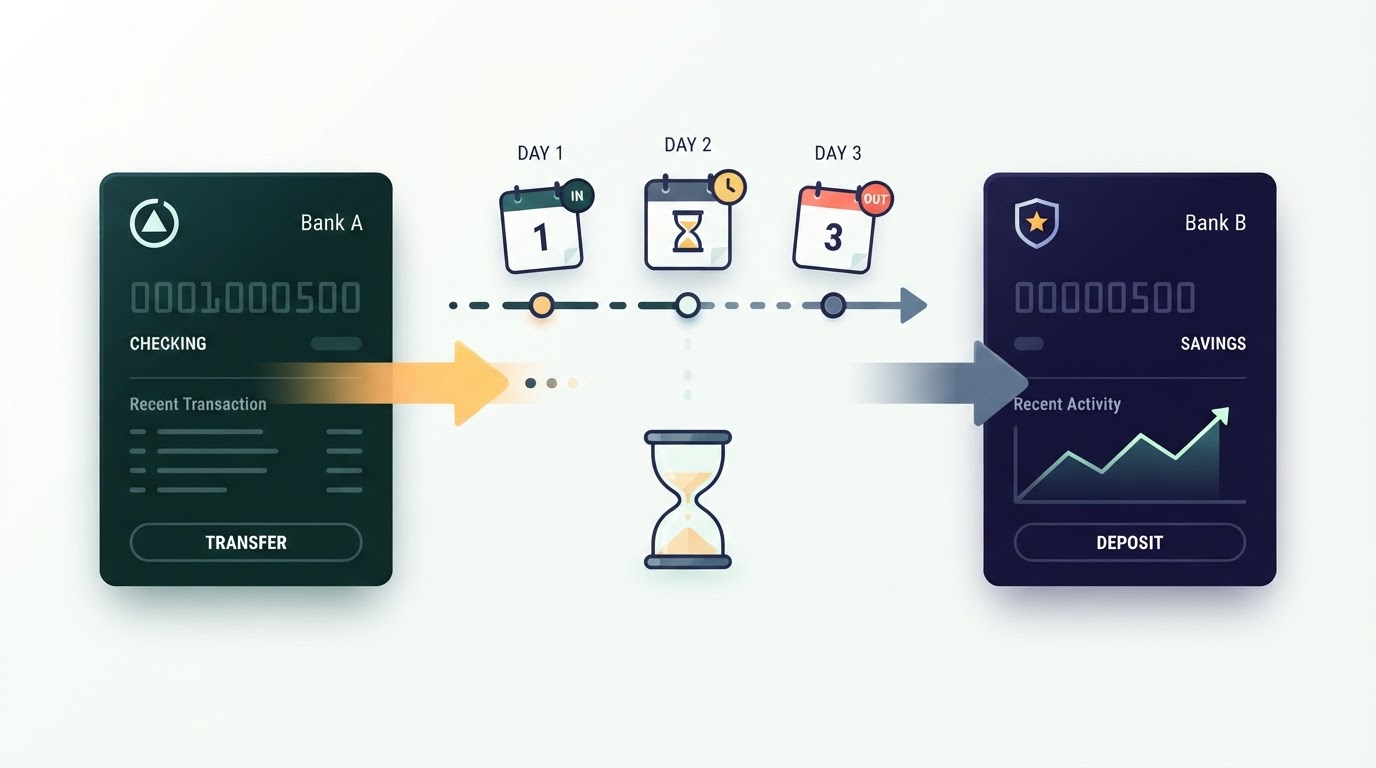
This one is low-tech but surprisingly effective for a lot of people. The idea is simple: open a savings account at a completely different bank from the one where your checking account lives. Transfer money there on payday. Then ignore it.
The friction here is not a penalty. It is time and inconvenience. Moving money between two different banks often takes two to three business days. That delay is enough to interrupt the impulsive spending cycle for many people.
How strong is the lock?
Moderate. It is psychological friction more than structural friction. Someone determined enough will wait out the transfer window. But for everyday temptation, a two-day buffer is genuinely useful.
What is the upside?
Zero fees, no penalties, no complicated setup. You could do this today with any bank account you already have.
What is the downside?
There is nothing stopping a sufficiently motivated person from spending the savings. If your problem is serious, the delay alone may not be enough. And like the HYSA situation, there is no goal attached to the money, which weakens the motivation to protect it.
Best for: People who overspend savings mainly due to impulsive decisions and just need a small delay in the circuit.
Option 4: Fixed-Term Savings Bonds
In the United States, Series I Bonds and EE Bonds from the Treasury are another locked option worth knowing about. I Bonds in particular got a lot of attention when inflation ran high, because they pay a rate tied to the inflation index.
The lock on I Bonds is meaningful: you cannot redeem them at all for the first twelve months. After that, if you redeem before five years, you forfeit the last three months of interest.
How strong is the lock?
Strong for the first year, where there is no access at all. After that, moderate. The three-month interest forfeit is real but not devastating.
What is the upside?
Inflation protection, government backing, and a genuine hard lock for at least a year. If you are building an emergency fund you truly do not want to touch, the one-year minimum holding period is actually a feature, not a bug.
What is the downside?
There is a $10,000 annual purchase limit per person for I Bonds. They are not goal-oriented in any visual or motivational sense. The interface for buying them (TreasuryDirect.gov) is famously clunky. And rates fluctuate, so the attractive rates that got them attention a few years ago are not guaranteed to persist.
Best for: Long-horizon savers with a specific amount they want protected from both inflation and their own impulses for at least a year.
Option 5: Locked Goal Savings Apps
This is a newer category and the one that is most directly designed for people who keep spending savings before reaching a goal.
Rather than locking money based on a time schedule, these apps lock it based on a named goal you set in advance. You pick what you are saving for, contribute toward it, and the money stays locked until you either reach the goal or decide to quit early.
Bloomin is one example of this approach. Here is how it works:
- You pick a named goal type, like vacation, emergency fund, home down payment, vehicle, or education.
- You contribute money toward it from a saved payment method.
- The money is locked once contributed.
- If you complete the goal, you pay a 1% finish fee to unlock it.
- If you quit early, you lose 25% of the balance as a penalty.
The penalty structure is where this diverges most sharply from everything else on this list. A 25% early exit penalty is not trivially small. If you have saved $2,000 toward a goal and quit, you lose $500. That is meaningful enough that most people think hard before walking away.
Bloomin also caps active goals at five at a time. That limit is intentional, to stop people from spreading savings so thin across too many goals that none of them feel real.
How strong is the lock?
Very strong, by design. The penalty is the largest of any option covered here when expressed as a percentage of saved funds.
What is the upside?
The goal-first structure keeps motivation tied to something specific. Every dollar has a named purpose before it is contributed. The consequence is visible before any money moves. And the app is built specifically for people who already know they have a habit of touching their savings.
You can read more about how to frame different types of savings goals in this Bloomin post on what are the three types of saving goals, which is useful for deciding how to structure what you are saving for.
What is the downside?
The penalty works both ways. If a genuine emergency comes up and you need that money, you lose 25%. That is a real cost, which is why it is worth thinking carefully about whether the goal you are locking is truly separate from funds you might need in a crisis.
It also requires trust in the app. Because this is a newer product category, doing due diligence before moving significant money into any locked app is sensible. Bloomin is currently in a waitlist phase, so early adopters can join the list here.
Best for: People who have already tried the willpower approach, tried moving money to a separate bank, and still keep spending it before reaching their goals. This is for people who genuinely need the consequence to be sharp enough to matter.
How to Compare These Options Side by Side
Here is a quick breakdown of how these options stack up on the dimensions that actually matter for someone trying to lock savings.
| Option | Lock Strength | Goal-Oriented | Penalty for Early Exit | Best Access to Funds |
|---|---|---|---|---|
| CD | High | No | Yes, interest forfeited | At maturity |
| High-Yield Savings | Low | No | Minimal | 1 to 2 business days |
| Separate bank account | Low to moderate | No | None | 2 to 3 business days |
| I Bonds | High (first year) | No | 3 months interest | After 12 months min |
| Locked goal app (Bloomin) | Very high | Yes | 25% of balance | Only at goal completion |
The table above is not about which option is objectively best. It is about which lock matches the size of the problem you actually have.
If you are a relatively disciplined saver who just wants better returns, a HYSA is probably right for you. If you have some lump sum to protect for a defined period, a CD or I Bond might work well. If you keep spending savings no matter what you try, a locked goal app with a genuine penalty is probably the only thing with teeth sharp enough to make a difference.
Who Each Option Actually Suits
The lump-sum saver
You already have money saved, you are not likely to touch it impulsively, and you want to earn something decent on it while it sits. A CD or a HYSA is the right move. The lock is secondary; you mainly want a return.
The goal-oriented saver who loses focus
You start strong, contribute for a few weeks, and then a sale or an unexpected expense convinces you to raid the fund. You need something that keeps the goal visible and makes walking away feel costly. A locked goal app is designed specifically for this pattern.
The emergency fund builder
You know you should have three to six months of expenses saved somewhere safe. But every time you get close, something comes up. A CD or an I Bond works here if the emergency fund is truly separate from your immediate financial needs. A locked goal app also works if you want the goal framing to keep the purpose clear.
For a useful framework on how to think about savings goal types, the three types of saving goals post on the Bloomin blog breaks it down clearly.
The person who keeps moving money back
You transfer money to savings. You transfer it back. You transfer it again. The normal banks make this too easy. You need either a longer transfer delay (separate bank), a hard time lock (CD or I Bond), or a real financial penalty (locked goal app). The right choice depends on how severe the habit is.
The person who wants to automate and forget
If the goal is to automate contributions and not think about it, a HYSA with automatic transfers is the simplest setup. The risk is that you will also stop thinking about it when you spend it.
The One Thing All These Options Have in Common
Every locked savings option on this list works on the same underlying principle: it raises the cost of touching the money before you are ready.
That cost might be lost interest, a waiting period, a government-imposed penalty, or a straight-up fee. But in every case, the mechanism is friction, not discipline.
This is actually good news for anyone who has felt guilty about raiding their savings. The problem is rarely that you are undisciplined or bad with money. The problem is that ordinary savings accounts make it nearly frictionless to move money back out. When the default is easy access, most people will eventually take it.
The accounts and apps that work are the ones that change the default. They make staying in easier than getting out.
If you want to understand the behavioral mechanics behind this in more depth, the Bloomin post on what the 27 40 rule is is worth reading. It covers a simple rule for thinking about savings timing and commitment in a way that applies across different goal types.
Putting It Together: How to Actually Choose
Before picking an account type, answer these three questions honestly:
1. How bad is the habit, really?
If you have dipped into savings three or more times in the past year despite telling yourself not to, a low-friction option like a HYSA or a separate bank account is probably not enough. You need something with a real penalty attached.
2. Is this money earmarked for something specific?
If you can name the goal, the date, and the rough amount, you will benefit from a goal-oriented lock. If it is just general savings without a clear purpose, a time-based lock like a CD may be more appropriate.
3. What happens if you genuinely need the money early?
This is the question most people skip. If you are locking your entire liquid savings, a 25% penalty could be devastating in a real emergency. Keep a small accessible buffer somewhere before locking the rest. The goal savings should be separate from your emergency fund, not a substitute for one.
Once you have honest answers to those three questions, the right option on this list becomes fairly clear.
Final Thoughts
There is no single best locked savings account. There is the right one for your specific pattern.
If discipline has worked in the past and you mainly want to optimize returns, a CD or HYSA gets the job done. If you keep spending savings before you reach goals and you are tired of the cycle, something with a genuine consequence attached, like a locked goal app with a meaningful early exit penalty, is probably the only thing that will actually change the outcome.
The important shift is recognizing that the problem is not you. It is the design of the tools you have been using. Normal savings accounts are not built for people who struggle to leave money alone. Locked options, across all their variations, are.
If the locked goal app model sounds like what you have been missing, Bloomin is built specifically for this problem. It is currently in a waitlist phase, and you can join the list to get early access when it opens.