 Bloomin
The 52-Week Money Challenge: Save $1,378 in a Year
The 52-week money challenge saves $1,378 in a year: $1 in week one, $2 in week two, up to $52. Here is how it works, the reverse version, and how to finish it.
Published 7 min read

The 52-week money challenge saves $1,378 in a year. Save $1 in week one, $2 in week two, and add $1 each week until $52 in week 52. That is the whole challenge.
That is also why it works. The first weeks ask for almost nothing, so starting is easy, and by the time the amounts get serious you have months of proof that you can do it. The rest of this post is the math behind it, the versions that make it easier to finish, and the trap that makes most people quit in November.
How does the 52-week money challenge work?
The challenge has three parts: a week number, a dollar amount that matches it, and a running total. Week 1 is $1. Week 2 is $2. Week 52 is $52. The total is 52 times 53 divided by 2, which is $1,378.
| Weeks | You save each week | Running total by end |
|---|---|---|
| 1-13 | $1 to $13 | $91 |
| 14-26 | $14 to $26 | $351 |
| 27-39 | $27 to $39 | $780 |
| 40-52 | $40 to $52 | $1,378 |
Two things worth noticing. First, the average is about $26.50 a week, which is roughly the cost of a takeout meal. Second, the money is backloaded: more than 43% of the total ($598) lands in the last 13 weeks. That shape is the challenge's strength and its weakness, and the versions below exist to fix the weakness.
If you would rather not track the weeks by hand, the 52-week savings challenge lays out every week with real dates, forwards or backwards, and prints a chart to tick off.
The reverse version: same total, easier finish
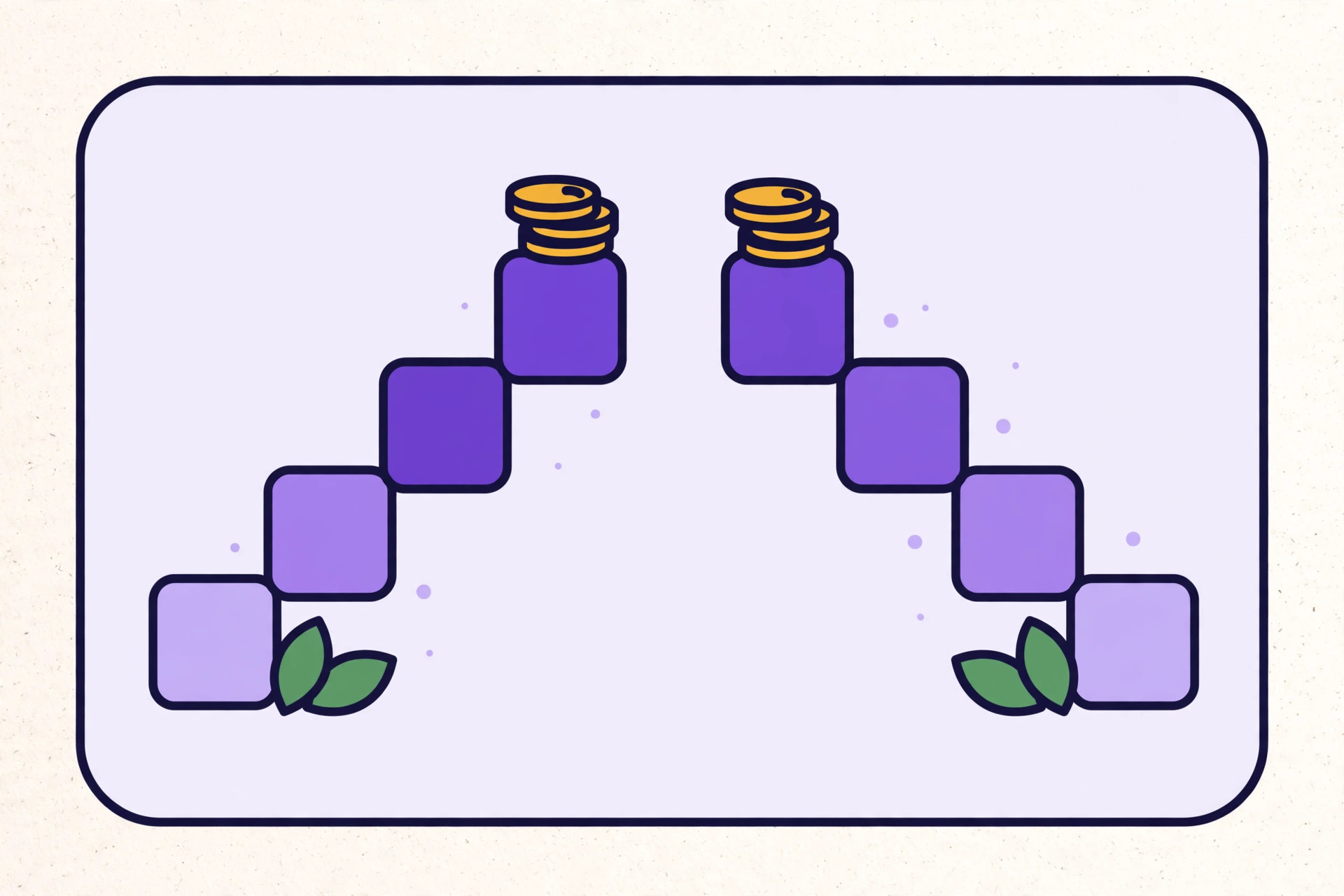
The reverse version flips the challenge: $52 in week one, $51 in week two, down to $1 in week 52. The total is still $1,378, but the shape is kinder. The heavy weeks land in January and February, when New Year motivation is strongest. The end of the year, with holidays, gifts, and travel, only asks for a few dollars a week.
The difference shows up most clearly when someone quits. Compare what each version has saved at the same point:
| You quit after week... | Classic saved | Reverse saved |
|---|---|---|
| 4 (end of January) | $10 | $202 |
| 13 (end of Q1) | $91 | $598 |
| 26 (halfway) | $351 | $1,027 |
| 39 (end of September) | $780 | $1,287 |
| 47 (Thanksgiving week) | $1,128 | $1,363 |
Quit at the halfway point and the reverse version has saved nearly three times as much. That is the real case for running it backwards: most challenges are not finished, so the version that banks the money early wins even when it is not completed.
The honest downside is that January is also when holiday credit card bills arrive. If your January is already stretched, the reverse version asks for $202 in the first four weeks, which is a lot to find right after the holidays. In that case the flat version below may suit you better.
The flat version and the payday version
If neither the classic nor the reverse shape fits your year, two more versions keep the same $1,378 total.
Flat: $26.50 every week. Same amount, every week, no hard stretch at all. Round up to $27 a week and you finish with $1,404, which is $26 over the target. The flat version is the least exciting and the most likely to be finished, because no week ever surprises you.
Payday pairs: two weeks per paycheck. If you get paid every two weeks, combine two challenge weeks into one payday deposit. Weeks one and two together are $3, weeks three and four are $7, and the last payday is $103. There are 26 deposits and the total is still $1,378. If even that feels steep, a lighter version deposits $2, $4, and so on up to $52 per payday, which adds up to $702 for the year.
| Version | First deposit | Last deposit | Year total | Hardest stretch |
|---|---|---|---|---|
| Classic | $1 | $52 | $1,378 | Oct-Dec |
| Reverse | $52 | $1 | $1,378 | Jan-Mar |
| Flat | $26.50 | $26.50 | $1,378 | None |
| Payday pairs | $3 | $103 | $1,378 | None, but varies |
Pick the version whose hard weeks fit your year, not the one that sounds most impressive. The version you finish is the one that works.
The month 11 trap
The classic version has a trap, and it is worth naming before you start. If you begin in January, the four or five weeks of November ask for about $230, while all of January asked for about $10. That spike lands on top of holiday travel, gifts, and food, which is why so many people drop out around Thanksgiving.
The trap is not the amount. It is the timing. The last 13 weeks are always the expensive ones, whichever month you start in. If you start the classic version in March, the expensive weeks land in February. If you start in June, they land in May. The fix is to pick a start month whose last 13 weeks land somewhere quiet, or to pick the reverse or flat version and remove the spike entirely.
A smaller version of the same trap is the biweekly paycheck. There are 26 biweekly paychecks in a year, not 24, because two months a year have three paychecks. If your challenge deposits ride on paydays, count the paydays on a calendar first. How much should I save per paycheck works through the same conversion with real numbers.
What if you miss a week?
A missed week does not break the challenge. You have three ways to handle it, and all three are fine:
- Add it to the next week. Missed week 20 ($20)? Deposit $41 in week 21 ($20 plus $21).
- Skip it and finish a week late. The total is the same, the finish date moves by one week.
- Restart the count. Only worth it if you are in the first few weeks and want a clean chart.
What does not work is treating a missed week as proof the challenge failed. The challenge is a habit, not a contract. The chart is the part that keeps people going: ticking off weeks is visible progress, and visible progress is what carries you through the expensive weeks at the end. Print the chart and put it somewhere you will see it every week.
For a daily version of the same idea, the $27.40 rule turns a $10,000 goal into $27.40 a day. It is the same trick at a different size: a small repeating amount, a visible total, and a date.
How a lock helps a challenge stick

A savings challenge fails the same way most savings plans fail: the money sits in an account next to checking, one tap moves it back, and the weekly deposit quietly becomes whatever is left at the end of the month. A lock changes that. The money is set aside toward a named goal and stays there until the goal is reached, so the decision you made when you started the challenge is the one that stands.
That is how a savings app that locks your money is built to work, and it is the idea behind Bloomin: money locked toward a goal until you reach it, up to 3 goals at a time, a 1% fee per deposit, a 25% cost to quit early, no interest earned, and it is not a bank. Bloomin is not open yet. You can join the waitlist at bloominapp.com/waitlist.
A 52-week challenge is one goal, so it takes one of the three slots. The other two are free for the next goal once this one is done, or for a second challenge running alongside it.
The 52-week money challenge is not a trick. It is a calendar, a small weekly amount, and a total that adds up. Pick the version whose hard weeks fit your year, start this week, and let the chart do the nagging.
Questions
How much money does the 52-week money challenge save?
$1,378. You save $1 in week one, $2 in week two, and keep adding $1 each week up to $52 in week 52. The numbers 1 through 52 add up to $1,378.
What is the reverse 52-week money challenge?
The same challenge run backwards: $52 in week one, $51 in week two, down to $1 in week 52. The total is still $1,378, but the heavy weeks land in January when motivation is highest, and the last weeks of the year only ask for a few dollars.
What happens if I miss a week of the 52-week challenge?
Nothing breaks. Add the missed amount to the next week, or pick up where you left off and finish a week late. The challenge works because the amounts are small and the habit is weekly, not because every week is perfect.
Can I do the 52-week challenge if I get paid every two weeks?
Yes. Combine two weeks into one payday deposit: weeks one and two together are $3, weeks three and four are $7, and so on up to $103 on the last payday. The total is still $1,378.
Where should I keep the money from a savings challenge?
Somewhere separate from everyday spending, so it does not drift back into purchases. A locked goal works well for this: the money stays set aside toward the goal until you reach it. Keep emergency money easy to reach instead.
Keep reading
 November 26, 2026
What Is a Sinking Fund? Save for Planned Expenses Before They Arrive
A sinking fund is money you set aside a little at a time for a planned expense, so the bill is covered before it arrives. Here is how to start one.
 November 25, 2026
How Much Should I Save Per Paycheck? Work Out Your Number
Work out how much to save from each paycheck from your own goal, date, and pay schedule, with worked examples for weekly, biweekly, and monthly pay.
 November 6, 2026
Locked Away Savings Account Options: How Hard Each Lock Really Is, and When It Fits
Locked away savings accounts compared: CDs, T-bills, I-bonds, retirement accounts and goal-locking apps. How hard each lock is, what breaking it costs, when it fits.