 Bloomin
How Much Should I Save Per Paycheck? Work Out Your Number
Work out how much to save from each paycheck from your own goal, date, and pay schedule, with worked examples for weekly, biweekly, and monthly pay.
Updated 7 min read

There is no single right amount to save per paycheck. The number that fits yours comes from three things you can pick yourself: how much you want to save, the date you want it by, and how often you get paid. Divide the goal by the number of paychecks before the date, and that is your per-paycheck amount.
That is the whole method. The rest of this post is working it out for real pay schedules, so you can check your own number instead of guessing one.
How to work out your number in three steps
Step 1: Name the goal amount. Pick a specific number, not a vague aim. $1,000 for a trip. $5,000 for a car down payment. $500 for a buffer. If the goal is fuzzy, the per-paycheck number will be too.
Step 2: Pick the date. A date turns the goal into a deadline. Six months from now. The end of next year. The day before the trip. Without a date there is no way to know whether the per-paycheck amount is on track.
Step 3: Count your paychecks before that date. This is the part people skip, and it is where most wrong numbers come from. How many paychecks land between now and the date depends on how you are paid:
- Weekly pay: 52 paychecks a year
- Biweekly pay (every two weeks): 26 paychecks a year
- Semimonthly pay (twice a month): 24 paychecks a year
- Monthly pay: 12 paychecks a year
Then divide. Goal amount divided by number of paychecks equals the amount per paycheck. Round up to the nearest dollar so small rounding gaps do not leave you short at the end.
If you would rather not do the division by hand, the how much should I save tool runs the same math from your goal, date, and pay schedule.
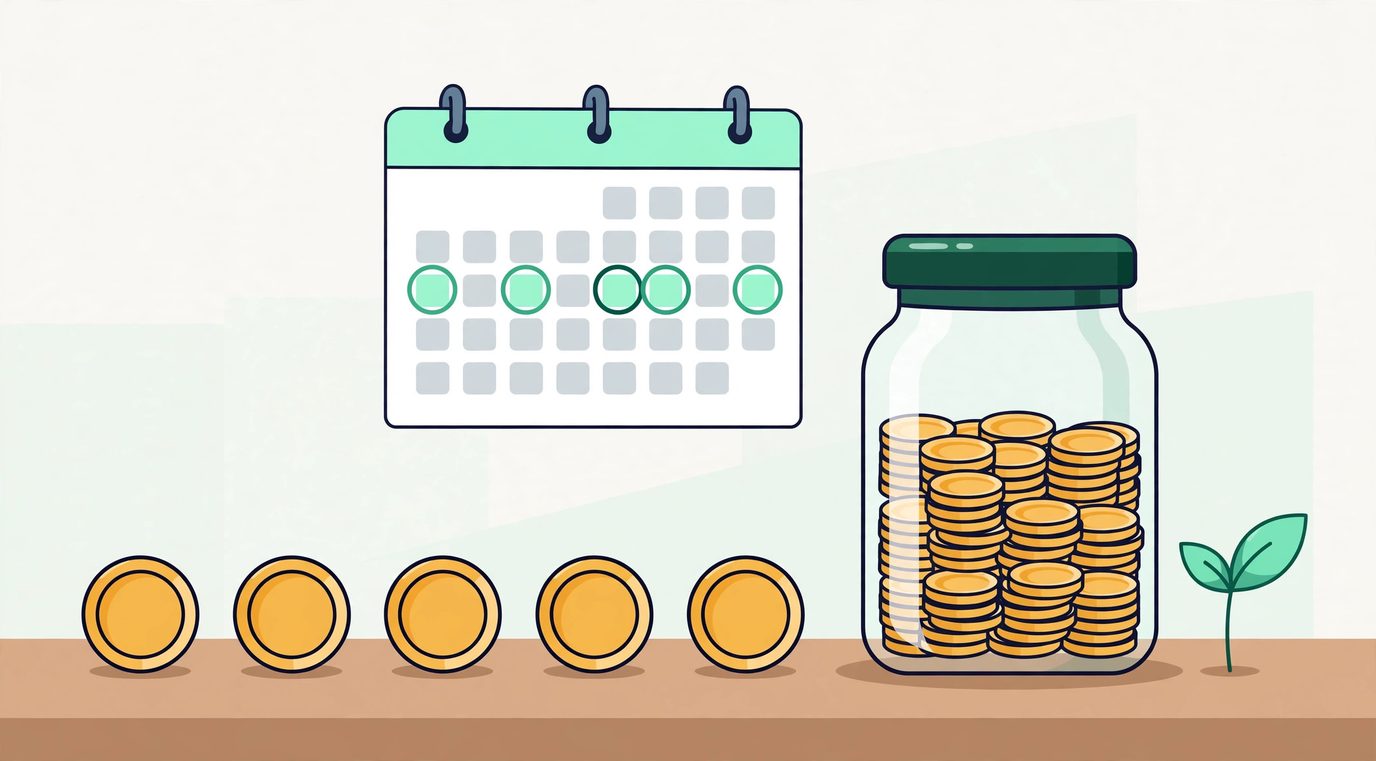
Worked examples: what the math looks like
Here is the same method applied to a few common goals. Every row uses the same rule: goal divided by paychecks before the date.
| Goal | Timeline | Pay schedule | Paychecks | Per paycheck |
|---|---|---|---|---|
| $1,000 | 6 months | Weekly | 26 | $39 |
| $1,000 | 6 months | Biweekly | 13 | $77 |
| $1,000 | 6 months | Monthly | 6 | $167 |
| $5,000 | 12 months | Biweekly | 26 | $193 |
| $5,000 | 12 months | Semimonthly | 24 | $209 |
| $10,000 | 12 months | Biweekly | 26 | $385 |
Two things worth noticing. First, the pay schedule changes the answer a lot: $1,000 in six months is $39 a week but $167 a month, and both are the same plan. Second, the numbers are not round, and that is normal. A per-paycheck amount of $77 or $193 is fine. Round numbers feel tidier, but the goal does not care whether the amount ends in a zero.
Humphrey Yang works through the same question with savings rate data from real incomes:
The same math in short form: this reel lists what to save per paycheck to reach $2,000, $5,000, and $10,000 goals in one year on biweekly pay.
Watch out for the biweekly trap
The most common mistake with biweekly pay is treating two paychecks a month as the whole picture. There are 26 biweekly paychecks in a year, not 24, because two months a year have three paychecks instead of two.
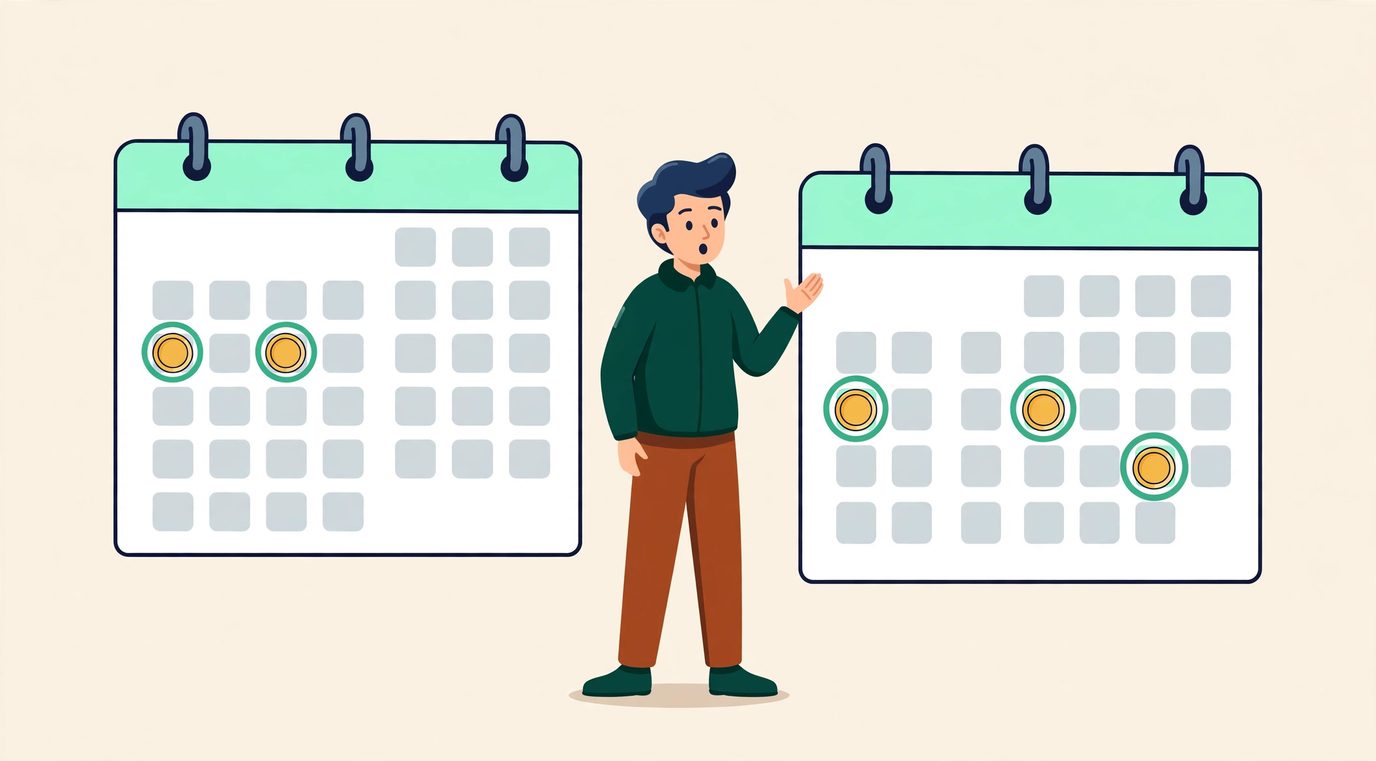
That changes the conversion. A $600 monthly savings target is not $300 per biweekly paycheck. It is $600 times 12 months, divided by 26 paychecks, which is about $277 per paycheck. Using $300 instead would save $7,800 in a year against a $7,200 target, so that mistake costs you extra savings, not a missed goal.
The trap runs the other way too. $300 per biweekly paycheck is not $600 a month, it is $650 a month, because there are 26 paychecks in the year. Budgeting $600 a month for a $300-per-paycheck plan leaves you $50 a month short. If you are paid biweekly, always convert through the yearly total: monthly target times 12, divided by 26.
This reel works through the same conversion for a six month goal on a biweekly schedule, including the $1,000 goal at $77 per paycheck from the table above.
What about the 50/30/20 rule?
The figure you will see cited most often is 20% of take-home pay, which comes from the 50/30/20 budgeting rule: 50% for needs, 30% for wants, 20% for savings and debt repayment. It is a useful reference point, and the 50/30/20 budget calculator shows what 20% is for your pay.
This reel covers the same 20% figure, and makes the case for starting at 5% and automating it if 20% does not fit yet.
But a percentage and a goal answer different questions. A percentage tells you what share of your pay goes to savings in general. The goal-first math in this post tells you what each paycheck has to carry for one specific thing by one specific date. If the two disagree, trust the goal math for the goal, and use the percentage as a check on whether the goal fits your overall budget. If you are saving for something specific, the savings goal calculator shows the same tradeoff from the other direction: how much per month to hit a date, or when you finish at an amount you can manage.
What if the number is too high?
Sometimes the math gives you a number you cannot afford, and that is useful information, not a failure. You have three ways to fix it, and only those three:
- Pick a smaller goal. Save $500 toward the trip first, then add a second goal for the rest.
- Move the date later. $1,000 in six months is $77 per biweekly paycheck. In twelve months it is $39.
- Start with what fits and raise it. Begin at half the number for a month or two, then step it up when you see it working. The plan still runs on the same math, just with a lower starting amount.
What does not work is keeping the goal and the date and hoping the money appears. The per-paycheck amount is the price of the goal on that date. Changing the price means changing the goal or the date.
How to make the amount stick
A per-paycheck number only helps if the money actually moves. The setup that works for most people has two parts: the transfer happens automatically on payday, before spending starts, and the money goes somewhere it cannot drift back from.
This short video covers the pay yourself first version of the same setup, saving on payday before spending starts:
That second part is where most plans fall apart. When savings sit in an account next to checking, one tap moves the money back, and the per-paycheck amount quietly becomes whatever is left at the end of the month. A lock changes that. The money is set aside toward a named goal and stays there until the goal is reached, so the decision you made on payday is the one that stands.
That is how a savings app that locks your money is built to work, and it is the idea behind Bloomin: money locked toward a goal until you reach it, up to 3 goals at a time, a 1% fee per deposit, a 25% cost to quit early, no interest earned, and it is not a bank. Bloomin is not open yet. You can join the waitlist at bloominapp.com/waitlist.
For the habits around the number, how to save money every month covers the routines that keep a per-paycheck plan running once the amount is set.
Your per-paycheck amount is not a judgment about how much you should be saving. It is arithmetic: a goal, a date, and a pay schedule. Work it out once, set the transfer to happen on payday, and let the number do its job.
Questions
How much should I save per paycheck if I get paid biweekly?
Divide your goal by the number of paychecks before your date. There are 26 biweekly paychecks in a year, so $1,000 in six months is 13 paychecks of $77. Round up to the nearest dollar so you stay on schedule.
Is there a percentage I should save from each paycheck?
There is no single right percentage. The figure people cite most often is 20% of take-home pay, from the 50/30/20 budgeting rule. A goal-first number is often more useful, because it is tied to an amount and a date instead of a rule of thumb.
What if I cannot afford the per-paycheck amount?
Change one of the three inputs: pick a smaller goal, move the date later, or start with an amount that fits and raise it after a month or two. The math still works, and a smaller amount saved every paycheck beats a bigger amount that never happens.
How does locking savings help a per-paycheck plan?
The money leaves checking on payday and stays locked toward the goal until you reach it, so it cannot drift back into spending. Bloomin works this way: up to 3 goals, a 1% fee per deposit, a 25% cost to quit early, no interest earned, and it is not a bank. It is on a waitlist and not open yet.
Keep reading
 November 27, 2026
The 52-Week Money Challenge: Save $1,378 in a Year
The 52-week money challenge saves $1,378 in a year: $1 in week one, $2 in week two, up to $52. Here is how it works, the reverse version, and how to finish it.
 November 26, 2026
What Is a Sinking Fund? Save for Planned Expenses Before They Arrive
A sinking fund is money you set aside a little at a time for a planned expense, so the bill is covered before it arrives. Here is how to start one.
 November 6, 2026
Locked Away Savings Account Options: How Hard Each Lock Really Is, and When It Fits
Locked away savings accounts compared: CDs, T-bills, I-bonds, retirement accounts and goal-locking apps. How hard each lock is, what breaking it costs, when it fits.